


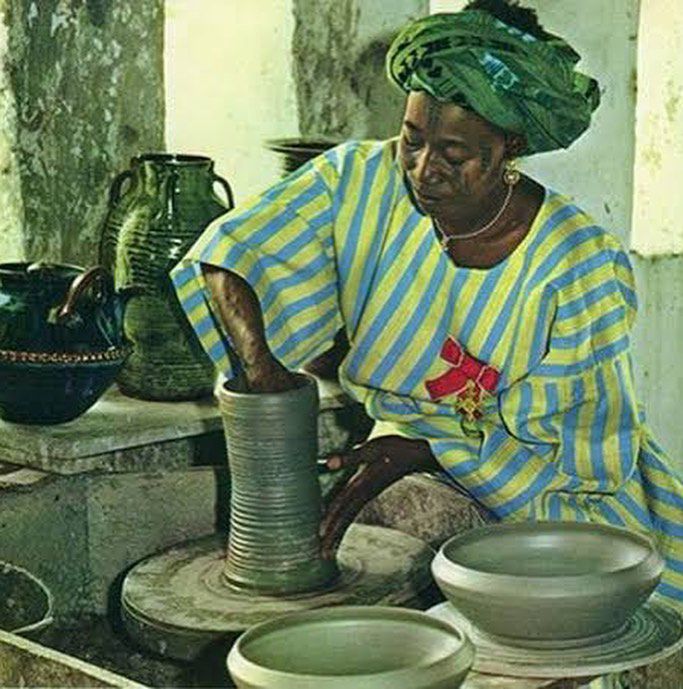
Ladi Dosei Kwali (born in the 1920s in Kwali, present-day Abuja, Nigeria) became one of Africa’s most celebrated potters and the first Nigerian woman whose artistry gained international recognition in modern ceramics. She grew up in a family of renowned Gwari potters and learned hand-built pottery from women who had passed the craft from one generation to the next. Her natural gift, precision and creativity transformed traditional Gwari techniques into artworks that caught global attention and elevated Nigerian pottery to museum status.
Ladi Kwali Early Life & Education

Kwali was born into a traditional Gwari family in the village of Kwali in northern Nigeria. In her community, pottery was a women-led craft, and she began learning it as a child by observing her aunt and other village potters. She developed skill rapidly and gained a reputation for her finely made, decorated water jars, bowls and cooking pots. Her works reflected the cultural imagery of her people — lizards, snakes, birds, and geometric patterns — all molded using the coiling method that defined Gwari pottery.
She did not receive formal Western schooling; her education came from artisanal apprenticeship, observation and constant practice. By early adulthood, her pottery had become so admired across rural Niger and Abuja that aristocrats purchased her pieces for palace use.
Ladi Kwali Major Life Events
Kwali’s career changed dramatically in the 1950s when British studio potter Michael Cardew, founder of the Abuja Pottery Training Centre, discovered her works displayed in the palace of the Emir of Abuja. He immediately recognized the artistic mastery in her traditional forms and invited her to join the Abuja Pottery Centre as its first female potter.
She accepted the invitation and began blending Gwari hand-building traditions with the glazing, wheel-throwing and kiln-firing techniques taught at the centre. Her natural talent allowed her to adapt quickly. She produced beautiful hybrids of African and Western pottery styles, astonishing visitors with the originality of her designs. Her pieces began touring internationally as examples of Nigerian craftsmanship.
Her work gained worldwide attention after appearing in exhibitions at institutions such as the Fitzwilliam Museum in Cambridge, the Berkeley Galleries in London, and galleries across Europe and America. These exhibitions marked the first time a Nigerian potter’s work achieved such global acclaim.
Ladi Kwali Professional Achievements
Kwali became the leading figure of the Abuja Pottery Centre and trained younger potters, including men, reversing the traditional gender roles that once restricted pottery training. She mastered glazing techniques, introduced modern artistic aesthetics into Nigerian pottery and produced signature stoneware pieces that combined incised Gwari motifs with glossy glazes.
She travelled internationally to demonstrate her craft, lecture on African pottery, and represent Nigeria at cultural exhibitions. Her works entered museums around the world, including the Victoria and Albert Museum in London. She became a cultural ambassador whose art symbolised Nigerian heritage.
In recognition of her contributions, the Nigerian government awarded her a series of national honours, including the Member of the Order of the British Empire (MBE) in 1963. Universities invited her as a lecturer and demonstrator; she later joined Ahmadu Bello University in Zaria as a teacher of ceramics. Her influence reshaped modern pottery education in Nigeria.

She received an honorary doctoral degree from Ahmadu Bello University for her outstanding artistic legacy. Her portrait eventually appeared on the Nigerian ₦20 note — the first Nigerian woman featured on the country’s currency — symbolising her national importance.
Ladi Kwali Personal Life
Kwali lived a modest life dedicated to her craft and cultural heritage. She never abandoned her Gwari roots and continued to use traditional coil-building methods even after mastering studio pottery. She remained deeply connected to her community in Kwali, where she encouraged younger women to pursue art and preserve indigenous ceramic traditions.
Although she travelled widely, she maintained her quiet, humble lifestyle and kept personal matters away from public attention. Her identity remained grounded in her craft, her faith and her cultural values.
Ladi Kwali Legacy & Impact
Kwali remains one of Africa’s most influential ceramic artists. She bridged traditional and modern techniques, opening the door for Nigerian pottery to enter gallery and museum spaces around the world. Her training of younger potters created a new generation of studio ceramicists in Nigeria. She also paved the way for women in art, proving that indigenous female artisans could gain recognition equal to globally trained artists.

Her artistic signature — traditional Gwari motifs fused with contemporary glazing — has become a defining style in Nigerian ceramics. Her legacy lives on in the Abuja Pottery Centre, in university curricula, in museums, on Nigeria’s currency, and in the global respect given to African pottery today.
Conclusion
Ladi Kwali transformed a village craft into world-class art. She rose from local pottery traditions to international exhibitions, mastered both indigenous and studio techniques, and became Nigeria’s most celebrated ceramicist. Her creativity, discipline and cross-cultural skills positioned her as a foundational figure in African art. She remains a symbol of cultural pride, artistic excellence and the enduring power of Nigeria’s traditional crafts.







Leave a Reply