


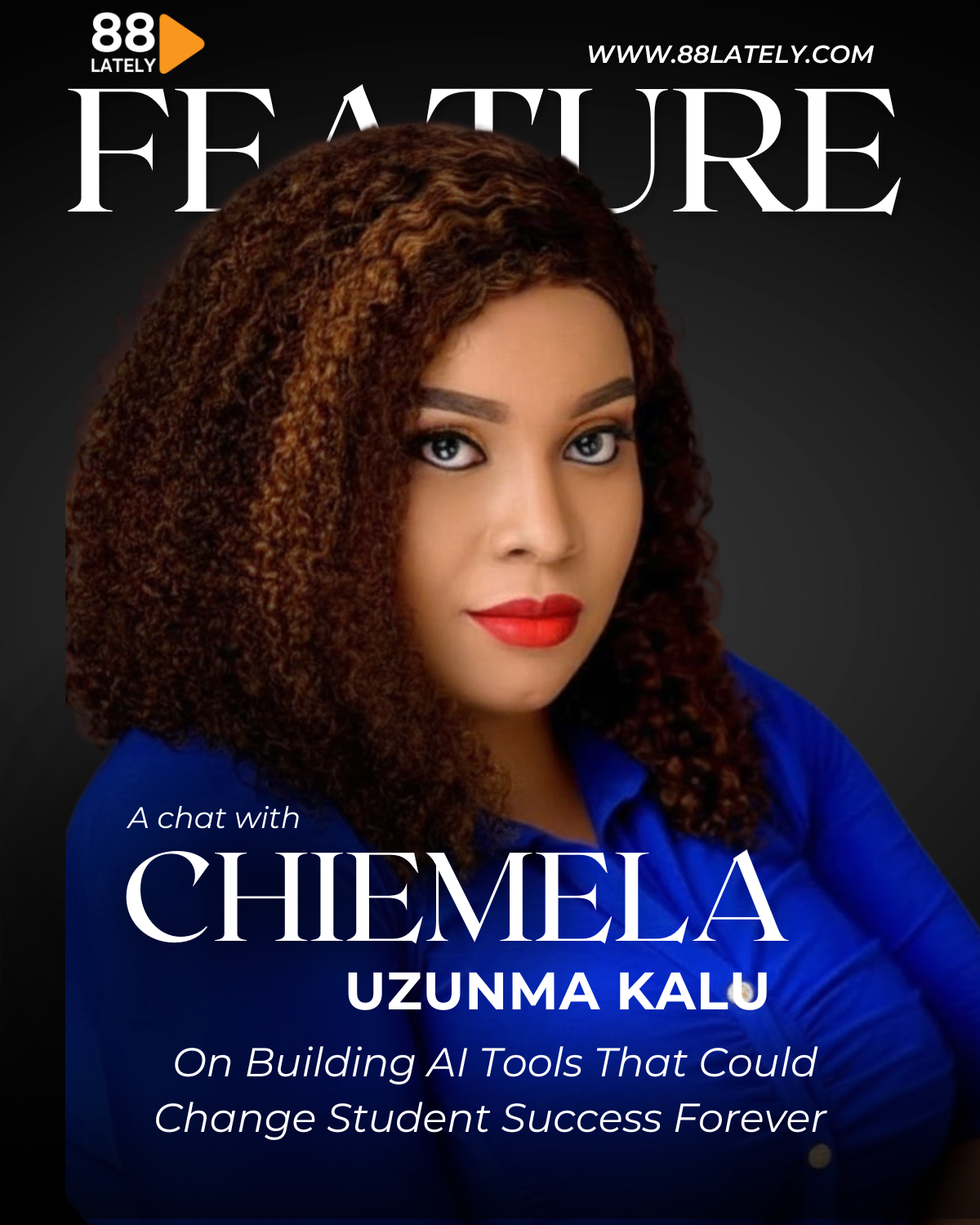
Born in Nigeria and now based in Maryland, USA, Chiemela Uzunma Kalu is part of a new generation of Africans redefining how technology can solve real human problems. A Business Systems Analyst, EdTech innovator, and emerging voice in artificial intelligence and higher education, her work sits at the intersection of data, equity, and student success.
Armed with a Master of Science in Information Systems and Sciences from Bowie State University, Chiemela has spent the last few years building systems that help institutions work smarter while helping students feel less invisible inside complex educational structures. Her most notable innovation so far is MISGPT, an AI-powered academic advising platform designed to give students real-time, institution-specific academic support using Retrieval-Augmented Generation (RAG) technology.
But beyond the technical language and systems architecture is a bigger mission: creating tools that close opportunity gaps, especially for underserved and first-generation students.
From Nigeria to the United States, from graduate teaching assistant to AI innovator and thought leader, Chiemela’s journey is one shaped by curiosity, precision, and purpose.
We sat with her to talk about MISGPT, the future of AI in education, navigating the diaspora experience, and why she believes technology should create opportunity — not confusion.
Let’s start from the beginning. Growing up in Nigeria, did you always know technology and systems thinking were paths you would eventually pursue?
Not consciously, no. But when I look back, the signs were always there. I was the child who wanted to understand how things worked, not just accept them as they were. I grew up in a household where education was treated as the most serious investment a family could make. My parents believed that knowledge was the one thing no one could ever take from you. That stuck. What I remember most vividly is a kind of deep impatience with inefficiency. Even as a teenager, when I watched processes fail people, whether it was administrative systems at school, queues that never moved, records that got lost, something in me wanted to fix it. I didn’t have the vocabulary to call that “systems thinking” then, but that’s exactly what it was. Nigeria gave me something that I consider one of my greatest professional assets: the ability to solve problems with limited resources. When the system doesn’t work, you improvise. You innovate. You build around the gap. That instinct has never left me, and it is the foundation of everything I build today.
Today you work as a Business Systems Analyst in the United States, but your work goes beyond traditional tech roles. How would you describe what you actually do to someone outside the tech world?
I tell people I am a translator. My job is to sit at the intersection of human problems and technical solutions and bridge the two. In practice, that means I work inside higher education institutions to understand how their systems, the software platforms, data structures, and administrative processes, are either serving students or failing them. I work with tools like Banner ERP, which manages student records, and DegreeWorks, which helps students and advisors track degree progress. My role is to ensure that those systems are configured, integrated, and optimized to produce accurate, useful outcomes.
But the part that goes beyond the job description is what happens when I identify a gap the existing tools can’t close. That’s when I start building. MiSGPT came directly from that place. I was watching students ask questions that the system technically had answers to but could never surface in a useful way. The information existed. The access didn’t. That’s a solvable problem and solving it became my mission.
For people hearing about MISGPT for the first time, what exactly is it and what problem were you trying to solve?
MiSGPT is an AI-powered academic advising prototype I developed as my final practicum project for my master’s degree at Bowie State University. It uses a technology called Retrieval-Augmented Generation, RAG, which means it does not just generate generic responses like a standard chatbot. It pulls from a curated knowledge base specific to an institution: degree requirements, course sequencing, academic policies, program details. The result is a system that can give a student a precise, contextually accurate answer about their academic path at any time of day.
The problem it addresses is one that anyone who has been through higher education in America knows intimately: academic advising is chronically under-resourced. Students often cannot get appointments for weeks. When they do, the advisor may be overloaded and under-informed about that student’s specific situation. Meanwhile, students are making decisions about their coursework, their financial aid, their graduation timeline, decisions that have real, lasting consequences.
MiSGPT was my answer to that gap. Not to replace human advisors, but to ensure no student is left waiting when they need a clear, reliable answer right now.
You’ve said you created MISGPT after noticing students “falling through gaps that data could have closed.” What were some of those gaps you kept seeing in higher education systems?
The gaps are everywhere once you know how to look for them. The most critical one is the advising gap. Institutions collect enormous amounts of data about student progress, grades, credit hours, course completions, financial holds, but that data lives in siloed systems that don’t talk to each other and rarely speak to the student directly. I watched students register for courses they had already taken because no one flagged the duplication. I saw students miss graduation because a prerequisite they thought was satisfied wasn’t recorded correctly. I saw first-generation students disenroll entirely because they couldn’t navigate the complexity of degree requirements without consistent guidance. These aren’t failures of student intelligence or effort. They are failures of institutional infrastructure. The data to prevent those outcomes existed. The systems to surface it proactively did not. That is exactly the kind of problem that AI-driven tools are uniquely positioned to solve, and it’s the problem that drives every project I work on.
A lot of people talk about AI in very broad or even scary ways. What makes MISGPT different from generic AI tools people already use every day?
The critical difference is grounding. When you ask a general-purpose AI tool a question about your degree requirements, it will give you a plausible-sounding answer based on general patterns in its training data. But that answer may not reflect your institution’s specific policies, your program’s current requirements, or the nuances of your academic record.
MiSGPT is architected differently. The RAG approach means the system is anchored to a verified, institution-specific knowledge base. It retrieves the most relevant content from that base before generating a response, which significantly reduces the risk of the model hallucinating or producing generic, inaccurate guidance. Think of it this way: a general AI gives you advice based on what it has read about universities everywhere. MiSGPT gives you answers based on what your university actually says. That distinction is not a technical footnote. For a student trying to figure out whether they can graduate on time, it is the entire difference between getting it right and getting it wrong
Your work focuses heavily on equity and underserved students. Why is that such an important part of your mission, especially as someone who has experienced both the Nigerian and American education systems?
Because I have been that student. I know what it feels like to be inside a system that was not designed with you in mind, where the expectation is that you will figure out the unwritten rules on your own, or fall behind trying.
When I got to the United States and entered higher education here, I had a master’s degree and professional experience, but I still encountered administrative systems so complex and opaque that I had to work hard just to navigate them. I had the tools. Many students do not. First-generation students, students from under-resourced communities, international students, students juggling work and family, carry the full weight of institutional complexity without the social capital that many of their peers inherit.
Technology has historically widened that gap. Poorly designed systems penalize people who don’t know how to navigate them. I want to build tools that reverse that dynamic, tools that meet students where they are, speak clearly to them, and remove friction rather than create it. Equity is not an add-on to my work. It is the reason the work exists.
You’ve spoken about the future of higher education moving from descriptive analytics to predictive intelligence. What do you think universities are still getting wrong about student success today?
The biggest mistake is mistaking reporting for insight. Most institutions have dashboards that tell them what happened, retention rates, graduation rates, grade distributions. Those numbers are important, but they are a rearview mirror. By the time a student appears in a retention statistic, the moment to intervene has often already passed.
Predictive intelligence is about identifying risk before it becomes a crisis. It’s about knowing, based on early signals in a student’s academic trajectory, that they are likely to struggle in a particular course, or disenroll before completing their degree, and then acting on that knowledge in time to make a difference. The data to build those models exists in every university’s system right now. The will to use it proactively is what’s missing.
There is also a tendency to treat student success as primarily a counseling or financial aid problem, when in many cases it’s an information problem. Students don’t fail because they don’t care. They fail because they don’t have the right information at the right moment. Fix the information infrastructure, and you change outcomes at scale.
Beyond MISGPT, you’ve also worked on projects like EmergencyAid and automated workflow systems for institutions. What draws you toward building systems that solve educational and operational problems?

Honestly, it is the same conviction: broken systems cost people more than time. They cost opportunity, dignity, and in some cases, safety. I have never been able to walk past a broken process without feeling a responsibility to address it.
EmergencyAid is a prototype I built around one of the most urgent versions of that problem. In a crisis, seconds matter, and the last thing a person should have to overcome is a language barrier. EmergencyAid delivers real-time emergency guidance through video, text, and audio, translated into over six languages, so that clear, actionable information reaches people in the language they actually think in. It placed second in the Revenue Generating Stage at Bowie State’s Bulldog Pitch Competition, and that recognition confirmed what I already believed: the need is real and the solution is something people would use.
The systems work I do at Covista, America’s largest healthcare educator, operates on the same principle at institutional scale. Covista serves more than 97,000 students across five accredited institutions and graduates roughly 24,000 healthcare professionals every year, including approximately ten percent of the nurses entering the U.S. workforce annually. At that scale, administrative inefficiency is not a minor inconvenience. It compounds. When I replace a manual, error-prone process with an intelligent, reliable system, I free up capacity across thousands of touchpoints. Every hour a staff member does not spend on a task a system could handle is an hour spent on work that requires human judgment. At Covista’s scale, that trade has real consequences for real students.
As a Nigerian woman building in AI and EdTech in the diaspora, have there been moments where you doubted yourself or felt underestimated? How did you navigate that?
Absolutely. To say otherwise would be dishonest. There are rooms I’ve walked into where the assumption was already formed before I opened my mouth, about what I knew, what I could build, what I deserved to be part of.
What I’ve learned is that doubt is information, not instruction. It tells me where I need to build more confidence or more evidence. It doesn’t tell me to stop. There is a distinction between imposter syndrome and legitimate preparation gaps, and getting clear on that distinction has been one of the most important pieces of work I’ve done.
I’ve also been deliberate about building a record that speaks before I enter a room. Every project I complete, every system I deliver, every piece I publish, that is documentation. It is proof, compounding over time. No one can argue with a working prototype. No one can dismiss a second-place finish in a competitive pitch competition. The work is the response to doubt.
And I want to be clear: this is not just a personal journey. Every time a woman from the continent builds something real and credible in this space, she opens a door slightly wider for the next one. That responsibility is not a burden. It is a privilege.
You’re not just building products — you’re also writing opinion pieces and contributing to conversations around AI and education policy. Why is thought leadership important to you?

Because technology does not deploy itself into a neutral world. It lands inside institutions, policies, and power structures that already exist. If the people building these tools are not part of the conversations shaping how they get used, then those conversations will happen without them, and the technology will reflect whoever was in the room.
I contribute to that conversation through writing on Medium and LinkedIn, and through peer reviewing journals and research papers focused on technology in higher education and AI in higher ed. That last part matters to me deeply. Peer review is not glamorous work, but it is how knowledge gets validated and built upon. Being part of that process as a practitioner, someone who works inside these systems daily, means I can assess research not just on methodological grounds but on whether it reflects what happens inside institutions.
I know what it looks like when a DegreeWorks configuration is wrong and a student receives inaccurate advising because of it. I know the gap between what a system is supposed to do and what it does inside a resource-constrained institution. That knowledge belongs in the research conversation, not just in internal project documentation.
Thought leadership is also the long game for the kind of impact I want to have. Tools can be deprecated. Institutions change. But well-argued, well-evidenced ideas about how technology should and should not be used in education travel further and last longer.
Outside tech, you’re involved in mentorship, Christian youth ministry, and women’s empowerment initiatives like “The Art of Your Becoming.” How do those experiences shape the kind of technologist and leader you are becoming?
They remind me who the work is for. It is easy in this industry to get so absorbed in architecture, data models, and deployment infrastructure that you forget you are ultimately building for people. Real people, with complex lives, real limitations, and immense potential.
Working with young people in ministry and mentorship keeps me grounded in the human stakes of what I build. When I sit with a teenager trying to figure out who they are and what they’re capable of, I am reminded of every student who has ever felt invisible inside a system that should have seen them. That experience doesn’t stay in that room. It comes with me into every design decision I make.
“The Art of Your Becoming” is about helping women step into their fullest selves, with intention, with community, with honesty about the journey. That’s the same philosophy I bring to my work in technology: build with intention, build in community, and be honest about what technology can and cannot do. The values are the same. Only the medium changes.
Looking ahead, what is the bigger vision for MISGPT and for your career overall? What kind of impact do you hope your work will have globally, especially in places like Nigeria and across Africa?
The bigger vision is a future where no student, anywhere in the world, loses their academic footing because they can’t access the right information at the right time. That’s the north star.
For MiSGPT specifically, the vision is large-scale deployment across K-12 and higher education institutions in the United States, Nigeria, and West Africa, and ultimately across continents. I am actively looking to collaborate with government to make that possible. Public sector partnership is the only realistic path to the kind of scale that changes outcomes at a population level, not just for the students who are lucky enough to attend a well-resourced institution.
I want to be honest: finances have been strained, and building at that scale as an independent innovator without institutional backing is genuinely hard. But that constraint has never changed the direction, only the timeline. The need is real, the technology exists, and the will is there. What is needed now is the right partnerships, the right investment, and the right moment. I am building toward all three.
For my career, I am building toward a role that sits at the intersection of innovation, policy, and practice, contributing not just to individual tools but to the frameworks and systems that determine how AI gets integrated into education at a structural level. I want to be part of shaping what responsible, effective AI adoption looks like in higher education, with Africa as both an audience and a contributor to that conversation, not just a recipient.
OUTRO
For Chiemela Uzunma Kalu, technology is not just about automation, dashboards, or artificial intelligence. It is about people. It is about making systems work better for those who are too often ignored by them.
Through her MISGPT prototype and her growing work in EdTech innovation, she represents a generation of African professionals using global knowledge to solve deeply human problems. Her journey from Nigeria to the United States of America is not simply a story about migration or career growth — it is a story about building tools with intention and using technology to create access, clarity, and opportunity.
And as conversations around AI continue to reshape education around the world, one thing is becoming increasingly clear: voices like Chiemela’s will help determine whether that future becomes more equitable — or more unequal.
For now, she continues to build, question, write, and innovate. And in many ways, this is only the beginning.






Comments (3)
SOLACE EKEsays:
May 28, 2026 at 6:45 amCongratulations 👏🎉 to you dear Sis!
May God continue to guide you every step of your way in Jesus matchless name.
Oluchisays:
May 31, 2026 at 5:46 amThis is an interesting and inspiring revelations on how AI can help not only students but researchers and corporate executives to seamlessly carry out their work! Thank you so much for this exposures!
Prof. Victoria N. Ezeanosays:
June 1, 2026 at 5:42 pmThis is a wonderful, challenging, and a very courageous move to provide solution to besetting problem in many our higher Institutions; coming as it were from our own daughter. More of God’s grace, dear