


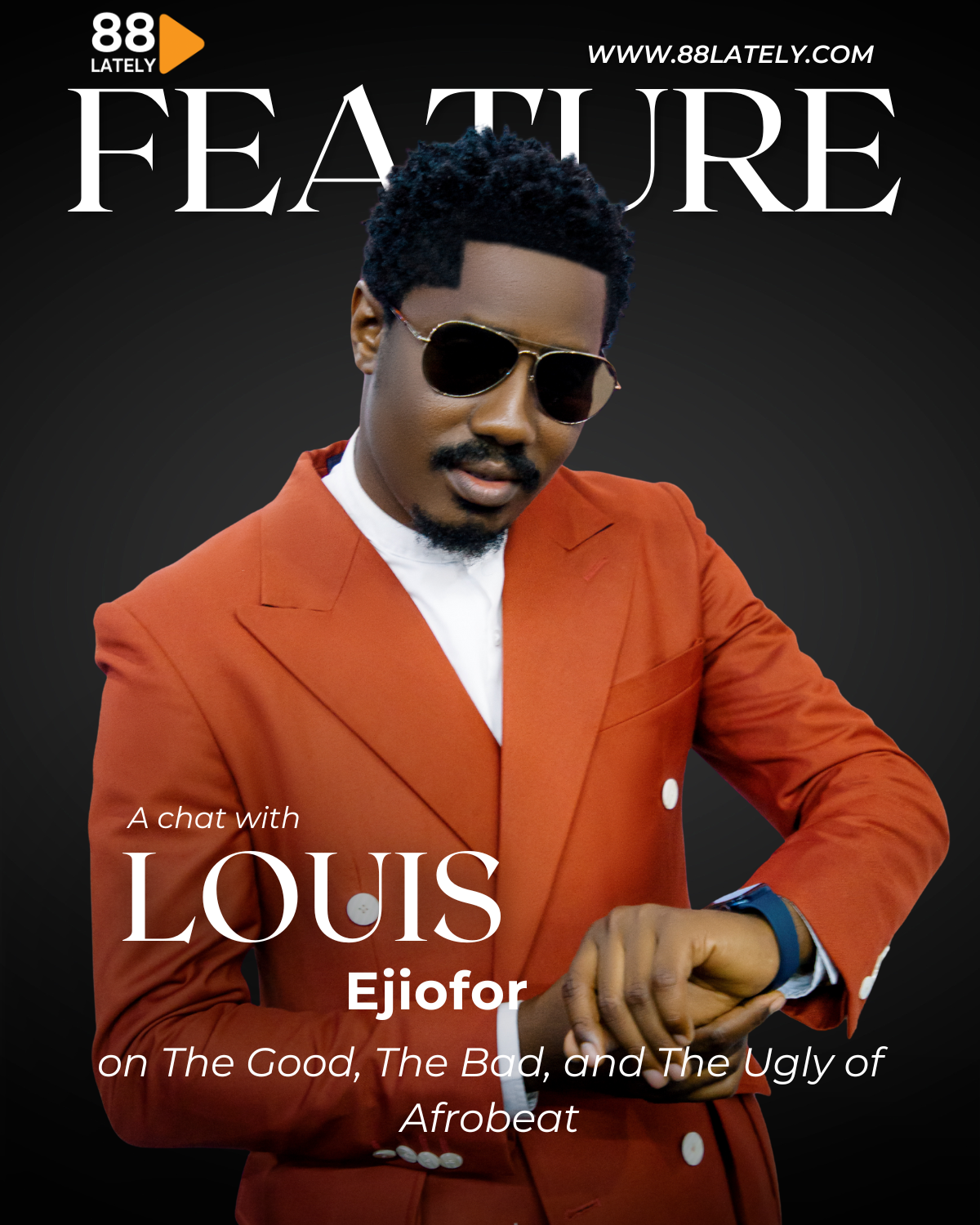
Louis Ejiofor has spent nearly a decade shaping stories at the intersection of culture, commerce, and cinema. As a creative director and film producer, he has led content campaigns for Monster Energy, Guinness World Records, Dangote Group, Huawei, Universal Music Africa and a long list of global brands. Now, he brings all of that experience into his most personal work yet — The Good, The Bad, and The Ugly of Afrobeat, a documentary series that digs beneath the rhythm to confront the realities behind Nigeria’s biggest cultural export.
The debut episode, The Pain Behind the Fame, featuring Cynthia Morgan, screened at AFRIFF where it sparked conversation, debate, and a renewed examination of the industry’s forgotten truths. With emotional interviews, layered reenactments, and a refusal to chase nostalgia, Louis presents Afrobeat as a living, complicated ecosystem shaped by power, pressure, and the resilience of its artists.
Louis, the Cynthia Morgan episode sets a bold tone for the series. What made you choose her story as the foundation and why was this the right time to tell it?
Cynthia Morgan’s story has always been larger than the way it was portrayed in public conversations. What drew me to her story was the way it exposes the realities of the industry with a clarity that is often missing. Her journey reflects talent, pressure, misunderstanding and the complex structure surrounding Afrobeat artists. It felt like a genuine entry point into a deeper and more honest conversation about the culture.

When we began shaping this series, I knew the first episode needed to carry emotional truth without leaning into sensationalism. Cynthia’s story contains all the layers we needed: success, vulnerability, loss, resilience and the consequences of decisions made by both individuals and the system. It gave us a chance to examine the environment around the music rather than simply focusing on personalities.
It is important to say that we approached her story in a completely journalistic way. We did not take sides. We did not try to paint anyone as a hero or a villain. The goal was to present facts, context and lived experiences with accuracy and fairness. We wanted viewers to draw their own conclusions based on a balanced presentation of the truth.
This felt like the right time to tell the story because Afrobeat is now a global force. With that kind of spotlight, there is a risk of rewriting history or ignoring uncomfortable realities. By documenting Cynthia’s journey now, we are preserving an honest record of the ecosystem behind the music. It sets the tone for the entire series. Honest. Balanced. Human.
The Good, The Bad, and The Ugly of Afrobeat is structured in modular episodes, each beginning and ending its own subject rather than following a serial plotline. What inspired that storytelling style, and what do you think it allows you to do differently ?
The modular structure came from the reality of the Afrobeat ecosystem itself. Each story stands on its own. Each artist faces a different set of pressures, victories and challenges. Trying to force all of that into a traditional serial arc would have limited the honesty of the series.

By giving every episode its own beginning and end, we are able to dive deep into one subject without being distracted by the need to build a single storyline. It allows us to treat every topic with fresh eyes and the level of detail it deserves. This format also lets viewers explore the series in any order, which mirrors how people engage with the culture. Afrobeat is not linear. It grows, shifts and reacts.
The modular approach gives us room to be more truthful, more focused and more respectful of each story’s uniqueness.
How many episodes will the full series contain, and who are some of the other artists or subjects we should expect to see in future episodes?
We are developing this as a limited five-episode series, with each installment exploring a different layer of the Afrobeat ecosystem. Each episode must earn its place. The priority is depth, accuracy and fairness, not speed.
Right now, we are close to completing the episode titled Where Is Jesse Jagz. His story is one of the most fascinating in the industry. It looks at genius, reinvention and the cost of choosing your own path. It opens an entirely different conversation about creativity and independence in Afrobeat.
Beyond Jesse Jagz, my team and I are still working through thorough research and developing stories for our forthcoming episodes. It is a lot of work, and we signed up for it. We hope to feature voices like Tiwa Savage, Zinoleesky and Don Jazzy. Each of them brings a unique perspective on fame, pressure, influence and legacy, and that diversity is what will keep the series honest and unpredictable.
What excites me is that every episode stands on its own. Viewers are not just watching an industry; they are discovering the real experiences of the people who built it. That is the heart of this project.
Beyond the headline figures, you brought in a wide mix of voices including Daniel Regha, someone many wouldn’t immediately expect in a music documentary. What shaped your criteria for selecting the people who comment on each subject and how did you know it will work so well?
When we decided to include voices like Daniel Regha, who I jokingly call “Twitter Gangster” hahaha, alongside musicians, insiders, and traditional commentators, it was intentional. We did not want familiar faces giving familiar takes. We wanted honesty, perspective, and unpredictability. Daniel delivers that. He speaks with a boldness many avoid. He might be controversial, but he forces you to think in ways you would not expect.

Our selection criteria for commentators have always focused on truth over comfort. Who sees the industry from a different angle? Who is willing to speak up when many stay silent? Who brings lived experience and sharp insight? Daniel meets those standards. He does not just echo safe opinions. He reacts, analyzes, and challenges. That kind of commentary is necessary and valuable.
We believed it would resonate. When we screened at Alliance Française in Ikoyi, and later at AFRIFF 2025, Daniel’s segment energized the room. People laughed, debated, and questioned. No one was bored. The screening turned into a discussion and a moment of real reflection.

This documentary is not just for fans. It is for anyone ready to see Afrobeat in its full complexity, the highs and the lows. Including voices like Daniel’s gives us room for honesty and real talk. That is what this project stands for.
Many Afrobeats documentaries lean on nostalgia or celebratory storytelling. Yours details like — confronts contracts, pressure, exploitation and the “fine print” of being an artist. Why did you take this direction, and what impact do you hope it makes on young artists entering the industry?
Most Afrobeat documentaries celebrate the music and the glamour, and there is value in that. We chose a different direction because the reality behind the music is often hidden. Contracts, pressure, exploitation, and the fine print are part of the story, and ignoring them would be a disservice to both the artists and the audience.
We wanted to show the full picture. This series is about honesty, not just admiration. It explores the challenges that shape creativity, the obstacles that define careers, and the systems that artists navigate every day. By confronting these realities, we give viewers an opportunity to understand what it really takes to succeed in the industry.
For young artists entering Afrobeat, the impact is simple but vital. We hope they watch and gain insight, clarity, and a sense of preparedness. This is not a cautionary tale meant to scare them. It is a guide, a reflection, and a reality check. Knowing the stakes early helps them make smarter choices, protect themselves, and still pursue their passion with eyes wide open.
The Cynthia Morgan episode brought clarity to an issue that has been debated for years. During your research and interviews, what truths or revelations stood out to you most?

The Cynthia Morgan episode revealed layers of the industry that many people overlook. What stood out most during research and interviews was the complexity of the challenges she faced. It is never just about talent or luck. It is about contracts, power dynamics, management decisions, and the pressure of public perception.
One of the clearest revelations was how little support artists sometimes receive when things go wrong. It is easy to assume failure is personal, but in many cases, it is systemic. Seeing that clearly was both eye-opening and humbling.
Another truth that struck me was her resilience. Despite setbacks and misunderstandings, Cynthia’s determination and creativity remained intact. That balance between vulnerability and strength is what made her story essential to the series. It is a reminder that Afrobeat is not just about hits and fame. It is about the people navigating an ecosystem that is both inspiring and unforgiving.
Your use of reenactments is visually striking and not very common in Nigerian music documentaries. What led you to incorporate reenactments, and how did you ensure they added emotional weight rather than distracting from the truth?
Reenactments were always part of the vision because storytelling in Afrobeat has often been limited to talking heads and archival footage. I wanted the audience to feel the stories, not just hear them. Seeing moments recreated with care allows viewers to step into the shoes of the artists, to experience their triumphs, their struggles, and their moments of doubt.
We were very deliberate in how we approached this. Every reenactment is grounded in fact. We used interviews, archival material, and extensive research to ensure authenticity. The goal was never to dramatize for entertainment’s sake. It was to add emotional weight, to make the challenges and victories tangible.
When it works, it bridges the gap between observation and empathy. People are not just watching; they are experiencing the tension, the pressure, and sometimes the heartbreak alongside the artists. That is why these moments stand out. They elevate the story without compromising the truth.
You’ve led production on major brand films, campaigns, and documentaries for almost a decade. Which of your previous projects best prepared you for executing something as emotionally and logistically complex as this series?
That’s a very interesting question. Nearly a decade of working across brand films, campaigns, and documentaries taught me that storytelling is as much about empathy as it is about execution. Every project presents its own challenges, but some prepared me more than others for a series like this.
One project that stands out was with an American NGO providing free heart surgeries for infants and young people. I produced and directed that project, and it came out so well that it led to multiple follow-up opportunities. It taught me how to handle sensitive subjects with care, coordinate complex teams, and craft a story that touches people emotionally while staying true to the facts.
All of that experience directly informed how we approached The Good, The Bad, and The Ugly of Afrobeat. Handling delicate interviews, reenactments, and multi- layered narratives required precision, empathy, and authenticity. This series is our first documentary feature ever, so every lesson from past projects became a building block. It pushed us to think creatively and strategically while holding space for real human stories that resonate.
You screened at AFRIFF and received a nomination there. Have there been other screenings, festival entries, awards, or upcoming platforms where the public can watch the documentary?
AFRIFF 2025 was an incredible moment for us, and receiving a nomination there was a huge honor. We are thrilled to share that the documentary has just been nominated for the REFFA Awards in Ghana for “Best Documentary,” marking its second major recognition.
Earlier, we also screened at Alliance Française in Ikoyi, and the audience response confirmed that people are eager for authentic stories about Afrobeat. Recently, I was invited to the Zurich Film Festival in Switzerland as an industry expert, which was an amazing opportunity to share insights from this project with global peers.

This documentary is one that everyone should watch. We are also exploring additional screenings and curated platforms so it can reach audiences who can engage with it deeply, whether they are industry insiders, fans, or young artists stepping into the scene. It is designed to be experienced, discussed, and reflected upon, and we cannot wait for more people to see it.
Every documentary comes with its own challenges — creative, financial, or operational. What were the biggest challenges you faced while filming this series, and what part felt the most rewarding?
Every documentary has its hurdles, and this series was no exception. One of the biggest challenges was securing interviews with some industry stakeholders. Some were hesitant to participate, while others requested unrealistic fees, which was especially difficult because this was a self-funded project. Taking that risk and investing so much of our own resources added another layer of pressure.

Another challenge was navigating sensitive subjects. We wanted to be truthful without sensationalizing, and that meant careful research, patience, and building trust with everyone involved. It was a delicate process, but essential to preserving the integrity of the series.
The most rewarding part has been seeing the moments come alive on screen. When viewers connect with an artist’s story, feel their struggle, and walk away with new understanding, that is incredibly fulfilling. From the reactions at AllianceFrançaise and AFRIFF to discussions sparked in the industry, those moments remind me why this project was worth every challenge.
Afrobeat is evolving faster than any genre in Africa. From your viewpoint as a filmmaker, what issues in the ecosystem worry you the most, and what changes would you love to see in the next decade?
Afrobeat is moving faster than any genre on the continent, and that kind of rapid evolution brings both excitement and real concern. From a filmmaker’s point of view, one of the biggest challenges is how unstructured the industry still is. Contracts are rarely clear, young artists step into fame without the tools to handle it, and exploitation becomes possible whenever there is confusion about who controls what.
That is why the documentary brings in voices who understand the weight of these issues. Talking to Amanda Iheme opened a door into the psychological toll fame can take long before an artist even realizes it. Conversations with Boye Debo- Akande, Esq. revealed how simple legal oversights can determine an artiste’s entire career path. Daniel Regha added context from a cultural and social standpoint, while Kachi Offiah from Arise TV helped unpack the crucial role media plays in shaping an artiste’s narrative.
Masterkraft gave raw insight into what it means to create under pressure, and Yeni Kuti grounded the project with perspectives on heritage and responsibility. Giovanni brought clarity from the music executive side, and Minnie Esu, our financial risk expert, shared practical ways artistes can protect themselves from financial collapse and build something sustainable.
What this project has made clear to me is that success in Afrobeat cannot be measured by fame alone. Behind every hit song is a complex system of choices, costs, pressures, and vulnerabilities that most people never see. My hope is that this series helps the next generation understand that talent may open the door, but knowledge, structure, and self-awareness are what keep that door open
Finally, what can audiences expect next from you — both in the future episodes of this series and in your career as a filmmaker? Are there new stories or themes you’re already preparing to explore?

Looking ahead, audiences can expect the next episodes of The Good, The Bad, and The Ugly of Afrobeat to continue diving deep into the realities of the industry. Each episode is designed to stand on its own while exploring different layers of the ecosystem. We are still in the process of thorough research and story development to ensure that every voice, every story, and every detail is meaningful and impactful.
Beyond this series, I am excited to continue exploring stories that matter, those that shine a light on culture, creativity, and the human experience. The documentaries we are working on are not following traditional formats. We are experimenting with a new style of documentary filmmaking that incorporates striking visuals, reenactments, and immersive storytelling. The goal is to make audiences feel part of the project, not just watching talking heads. We want people to be engaged from start to finish because attention spans are short and stories need to captivate, inform, and inspire.
I also want to take a moment to say thank you for having me on your page. This conversation has opened my eyes to the kind of impact these stories can have on people and that is an amazing thing. I am grateful for the opportunity to share this work, and I look forward to creating more projects that challenge expectations and make audiences feel connected to the stories we tell.
Bonus Question
It is quite noticeable that you used “Afrobeat” in response to the questions as against “Afrobeats” and the project is titled “The good, the bad and the ugly of “Afrobeat””. What informed that choice?
I chose to use Afrobeat without the ‘s’ for reasons that are both historical and personal. The ‘s’ was introduced by Ghanaian DJ Abrantee, who added it as a convenient way to group various Afrobeat-influenced songs on his radio playlist in the UK. While that served his purpose, it was never, in my view, substantial enough to redefine a genre with such deep cultural roots. It also invites a larger reflection. As Nigerians, custodians of one of the most influential sounds in the world, why do we so readily allow others to frame, rename, or reinterpret what we ourselves created?
Afrobeat remains the truest expression of our identity. Afro means Africa. Beat means sound. It literally translates to African sound. That name carries history, intention, and cultural integrity, none of which are heightened by adding an ‘s’. So for this project titled “The Good, The Bad and The Ugly of Afrobeat” I chose to remain with what is original, honest, and culturally grounded.
Closing Note
From just the first episode — The Good, The Bad, and The Ugly of Afrobeat feels like more than just a documentary but a cultural intervention. Through sharp research, bold visuals, and a willingness to confront uncomfortable truths, Louis Ejiofor is shaping a new lane for African music storytelling. As the series expands and his body of work grows, one thing is clear: he’s building films that both entertain and platform crucial conversations. And this is only the start.



Leave a Reply