


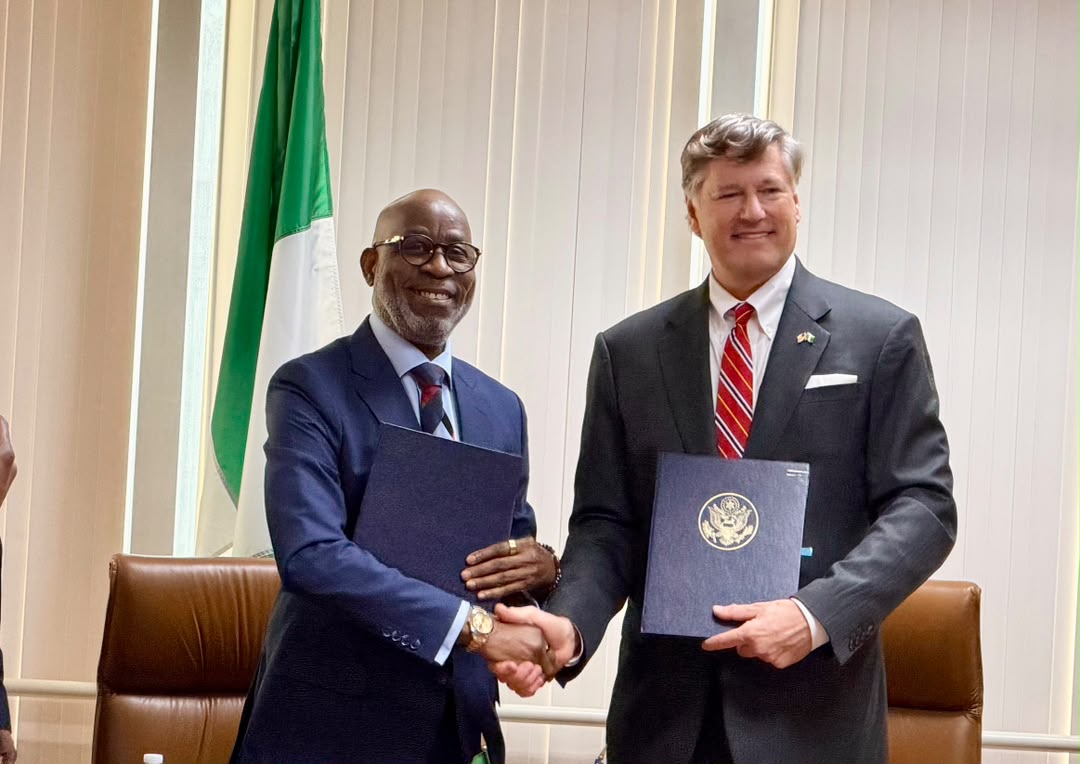
You have probably seen the headline everywhere: Nigeria has signed a $700 billion mineral deal with America.
It sounds like Nigeria has just secured a $700 billion investment from the United States in exchange for full access to Nigeria’s solid minerals.
That is not exactly what happened.
The $700 billion figure refers to the Nigerian government’s estimate of the value of the country’s mineral resources. It is not the amount America has agreed to invest, and Nigeria has not received a $700 billion cheque.
What Nigeria and the United States actually signed is a framework agreement to encourage American investment and cooperation in Nigeria’s mining and solid minerals sector.
And it could become a very important agreement if the plans eventually turn into actual mines, processing plants, businesses, jobs and investment.
So why does Nigeria need America to develop resources that already belong to Nigeria? Because having the minerals is not the same as having the capital, technology, expertise and infrastructure needed to develop them; the agreement creates a framework for American companies and investors to explore opportunities, but those companies will still decide which specific projects they want to invest in, or whether they want to invest at all.
What Was Really Signed?
The agreement was signed on September 23, 2026, at Nigeria’s Mission House in New York, on the sidelines of the 81st United Nations General Assembly.
Nigeria’s Minister of Solid Minerals Development, Dele Alake, signed for Nigeria, while US Deputy Secretary of State Christopher Landau signed for the United States.
Lagos State Governor Babajide Sanwo-Olu was among the Nigerian officials who witnessed the ceremony. Other Nigerian officials present included representatives of the Nigerian Mining Cadastre Office, the Solid Minerals Development Fund and the Nigeria Solid Minerals Company. The US delegation included officials responsible for West African affairs, foreign assistance and critical minerals. (Federal Ministry of Information)
So what does the agreement actually cover?
It creates a framework for cooperation in areas including geological data and exploration, mineral development and processing, infrastructure and technical capacity building. (Reuters)
In simple terms, both countries want to make it easier to discover Nigeria’s mineral resources, develop them, process more of them locally and attract businesses and investment into the sector.
But there is something very important to understand.
The signature itself does not mean America has invested $700 billion in Nigeria.
There is no announced $700 billion payment to Nigeria, no announcement that America has bought Nigeria’s mineral resources and no disclosed $700 billion mining project attached to the agreement.
Instead, the framework is supposed to create the conditions for future investments and business-to-business partnerships.
And Dele Alake himself made it clear that the signing is only the beginning.
According to the Federal Ministry of Information and National Orientation, Alake said:
“A signature is a promise, results are the proof.”
He explained that the next stage would involve identifying viable projects, mobilising investment and building commercial partnerships. (Federal Ministry of Information)
That distinction is important because Nigeria’s $700 billion mineral wealth is potential wealth, not $700 billion sitting in a bank account.
The country has valuable deposits, but they have to be properly explored, mined, processed and turned into commercially valuable products before that potential becomes real economic value.
What Does Nigeria Want From This?
Nigeria has spent decades depending heavily on crude oil for foreign exchange and government revenue.
The government now wants solid minerals to become another major part of the economy.
Nigeria has deposits of minerals including lithium, gold, tin and iron ore, among others, but much of the country’s mining industry remains underdeveloped.
The problem is not simply that Nigeria has not been mining enough.
It is also what happens after the minerals are taken out of the ground.
If Nigeria digs up a mineral and immediately exports it as a raw material, another country can do the processing, manufacturing and other higher-value activities.
That means much of the money and expertise created from the mineral can remain outside Nigeria.
This is exactly what Alake says Nigeria wants to change.
According to the Federal Ministry of Information and National Orientation, he said:
“We are not here to remain a source of raw material for the values that others create. Our goal is to turn potential into lasting value at home through stronger local processing, new skills, quality jobs, and new opportunities for Nigerian businesses.” (Federal Ministry of Information)
In very simple terms, Nigeria wants to move from:
Dig it → export it
to:
Dig it → process it → manufacture with it → create businesses and jobs around it → export higher-value products.
That is the bigger Nigerian ambition behind the agreement.
Why Does America Want This?
America has its own reason for being interested.
Many minerals are important for modern industries, including technologies connected to electric vehicles, renewable energy, electronics and advanced manufacturing.
The United States also wants to build more secure and diversified supply chains for what are known as critical minerals.
That means America does not want to depend too heavily on a small number of countries for minerals that are important to its industries.
Nigeria therefore becomes interesting because it has a large population, a significant economy and mineral resources that are still relatively underdeveloped.
There is also the growing global interest in Nigeria’s lithium industry, where Chinese companies have already become important investors.
So there is a potential meeting of interests.
Nigeria wants capital, technology, infrastructure, processing and new markets.
America wants stronger and more diversified sources of important minerals and stronger economic partnerships.
The agreement creates a framework for both sides to pursue those interests together. Reuters reported that the deal comes as Washington seeks to diversify critical-mineral supply chains and strengthen relationships with mineral-producing countries. (Reuters)
If This Goes Well, What Could It Do For Nigeria?
This is where the $700 billion figure becomes interesting.
If Nigeria can successfully develop its mineral resources, the impact could extend far beyond mining companies.
More investment could mean new mines, processing plants, roads, power infrastructure, logistics companies and manufacturing businesses.
Those businesses can create jobs directly and also create opportunities for other Nigerian businesses that supply them.
There could also be more foreign exchange coming into Nigeria through mineral exports.
Most importantly, Nigeria could begin building a new economic pillar alongside oil.
Imagine a Nigeria where crude oil is not the only natural resource attracting huge international investment.
A properly developed mining sector could mean Nigeria earns money from lithium, gold, tin, iron ore and other minerals, while Nigerian companies participate in more stages of the value chain.
But there is a big “if” here.
The agreement itself does not automatically create these benefits.
Nigeria will still have to attract actual investors, develop infrastructure, provide security, enforce regulations, protect host communities and make sure more processing happens locally.
That is why Alake’s statement about “results” is important.
The exciting part is the potential.
The real story will be what happens after the signing.
How Can Young Nigerians Position Themselves?
This is perhaps the most interesting part for young Nigerians.
When people hear “mining”, they may imagine someone digging for gold.
But a modern mineral industry needs far more than miners.
Think about the entire chain.
Nigeria will need people who understand geology, engineering, technology, data, environmental management, finance, accounting, law, logistics, construction, manufacturing, communications and business development.
There will also be opportunities for entrepreneurs.
If more mines and processing companies enter Nigeria, they will need local suppliers and service providers.
That could mean opportunities in areas such as transportation, equipment maintenance, software, security, catering, accommodation, consulting, media, marketing and professional services.
Young Nigerians can therefore start paying attention to the sector now instead of waiting until thousands of jobs suddenly appear.
For students, this could mean learning about industries connected to minerals and understanding where their skills fit.
For entrepreneurs, it could mean looking at the problems that mining companies will need to solve and building businesses around those problems.
And for everyone else, it is worth understanding that Nigeria’s natural resources are not valuable simply because they are underground. They become valuable when people have the knowledge, technology, businesses and infrastructure to turn them into economic value.
That may be the biggest lesson from this entire agreement.
The $700 billion headline is exciting, but the real opportunity is not that Nigeria has suddenly received $700 billion.
The opportunity is that Nigeria is trying to turn a huge amount of untapped mineral potential into an actual industry.
And as Dele Alake put it, the signature is only the promise.
Now comes the part that matters most: turning the promise into results.
Written by Folasade Abimbola






Leave a Reply