


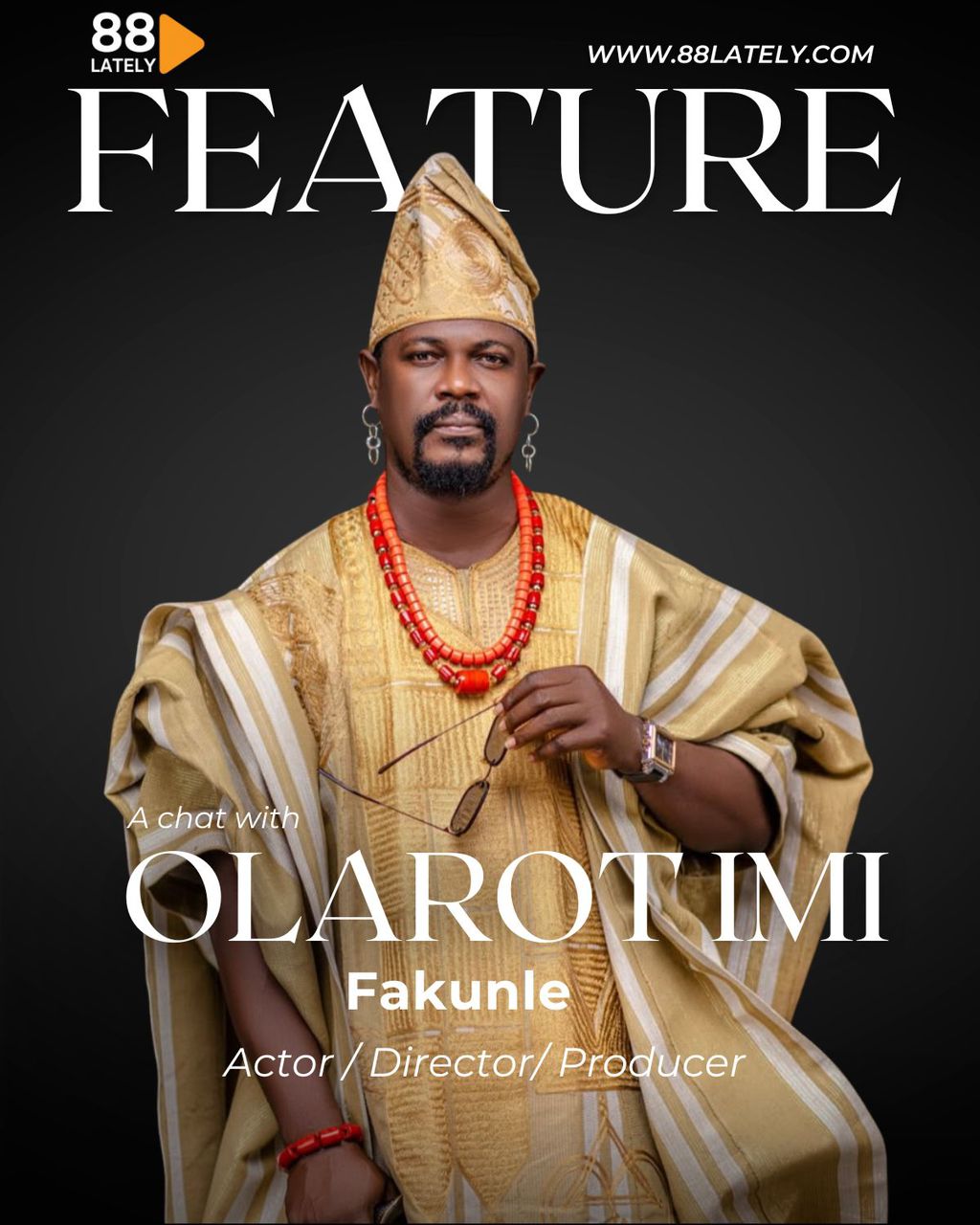
Olarotimi Fakunle is an accomplished actor, director, and producer whose work has left an undeniable mark on both stage and screen. Known for his compelling performances in projects like Ajochie, Paper Boat, Last Days, Kazeem in the Amazon Prime Original Gangs of Lagos and more recently Opa in The Fire And The Moth. Fakunle brings a powerful presence to every role he takes on.
A stalwart of Nigerian theatre, Olarotimi Fakunle has been involved in acclaimed productions of works by some of Nigeria’s most celebrated playwrights, including Wole Soyinka and Ola Rotimi. From The Lion and The Jewel to Death and the King’s Horseman, he has consistently elevated these classics for modern audiences. Beyond Nigeria, his talents have earned him international acclaim. As part of the Nigerian team at the Shakespeare Olympiad in 2012 and Renegade Theatre’s celebrated runs at the Edinburgh Festival Fringe, Fakunle brought Nigerian stories to a global stage. His work was recognized with the prestigious Mervin Stutter’s “Spirit of the Fringe Award” in 2014.
Now, with high-profile projects on the horizon, Olarotimi Fakunle is poised to continue his journey of storytelling and excellence. Let’s dive into a conversation about his career, his craft, and his vision for the future.
Let’s start with your name: OlaRotimi. Is that your birth name or a deliberate nod to the great playwright Ola Rotimi?
Olarotimi Fakunle is my name and Olarotimi is one word as against the great prof ,playwright Ola Rotimi. That’s my birth name.
You’ve had a long journey in acting, from theatre to screen. What originally drew you into performance, and how did your career begin?

I have had a long walk in this work but what drew me to this industry was in high school during poetry presentation and I would pick african poetry like Osun,Ogun I would dramatise it with my friends dressed as Ogun,Oya etc. Then I came to Lagos after my father who was a soldier was posted to Lagos. Continued my journey by going out. In 1997, I officially decided to join the theater with some guys, some of which are alive and some of which are dead
You’ve played complex characters across mediums; Opa in The Fire and The Moth, Marshal in Suki, and Kazeem in Gangs of Lagos. Which of these roles has been your favourite, and which challenged you the most?
I can’t outrightly pick some of the characters that will be unfair to other characters but some of the characters I have played still live rent free in my head. All the roles I have played have been challenging. It is difficult to pick a favourite. The more complex the character is,the more exciting and challenging it is.
Speaking of Kazeem, your performance in Gangs of Lagos was a breakout moment. How did you prepare for that role, and do you enjoy playing the “bad guy”?

It was a lot of work,I had to go to the market to visit the butchers and I had to pick one to learn under to know the process. I was fortunate to have learnt from the best. It was a lot of experience for me. I had to go to the street park with a couple of people and I had a lot of personal experience.
People often associate fame with youth. You “blew” at a more mature stage in life. Would you say that timing came with any advantages?
I believe in time, sometimes I don’t know what kept me going before breakout came but I know I loved what I did and I would rather not do anything else. I won’t advise young people to do the same because you have to have at least 3 incomes. Acting is hard and there are sometimes you would not get acting gigs. The advantage of the breakout prepared me for the work ahead.
I think I am more mature for my craft and job. I am a product of grace,I believe when it is not time it is not time.
You’ve been in the game long before many noticed. What are your thoughts on the concept of “blowing” overnight, and what kept you going through the years when the spotlight wasn’t on you?
I don’t think there is such a thing as blowing overnight. According to one of my great teachers who is late now. Wole Oguntokun who is late now would say there is nothing like spontaneous combustion. There will be years of training and you cannot quantify someone’s work based on their years of training. The concept of blowing can be misleading.
You’ve acted in many classics by Wole Soyinka and Ola Rotimi. What do those stories mean to you personally, and how do they inform your work as a modern actor?
Olarotimi:I have been fortunate to have performed some works of great playwrights, It is simply the way you appreciate literature because some of the lines are forever in your head. The trials of the brother Jero for example where Jero said “I am the prophet,the prophet by birth and by inclination”. It helps you understand Yoruba worldview. It helps you prepare for future works and also it helps you to understand literature more and then you come to appreciate the works of these people.
Let’s talk about theatre. How does working on stage influence your performances in film and television?
I’d say whether stage or tv, it is still the same. It is acting. In terms of preparation, a stage is better for you to equip because of the rehearsals. On the other hand film is not easy because of the number of retakes, especially when shooting emotional scenes where you have to dig into places of emotion to deliver your role perfectly. One is not higher than the other but in terms of preparations theatre is more disciplined.
You’ve represented Nigeria at the Shakespeare Olympiad and earned acclaim at the Edinburgh Fringe with The Waiting Room and The Tarzan Monologues. What stands out most when you look back on those international performances?
When I look at the international performances I have done, I look back at the power theater has in terms of outreach in reaching out to a lot of people and bringing them together.
I don’t know what other profession I would have done that would have given me that much outreach in terms of travelling, putting out my craft, I look back at those experiences and I really did enjoy it.
Do you feel actors in Nigeria get stereotyped, especially after breakout roles? Is that something you fear?

Well it happens not just in Nigeria but everywhere. It is not about the stereotype but the ability of the actor to play any role given. But also one should be careful not to fall into that trap. Initially I was but I have gotten to play other roles that have challenged me. Every film is different every time you get a role similar to the one you have played before, as an actor you must be able to play them differently so now I am not afraid to bring it on.
You’re not just an actor you also direct and producer. How do you balance all these roles without losing sight of the art?
When I’m acting most of the time I try not to be in a place where I am directing so I can give the directing my all.
Also as a director for the theater you’re the initiator of the entire process,you can’t afford for your head not to be in one place as you work with all the crew.
For me there is no distraction. When I am producing I sometimes direct but when I am acting,I am acting.
You’ve worked with several big names in the industry. Who has been your favourite actor to work with and why?
I have been fortunate enough to work with amazing people both old and young. I have enjoyed every part of my work and I have enjoyed playing alongside everyone I have acted with. I am a team player and I always try to make sure there is the same balance and relationship between me and my fellow actors.
I have worked with Sharon Ooja , Bimbo Ademoye, Ojopagogo, Tobi Bakare.
One standout collaboration was Ayetoro Town with Funke Akindele. What was it like working on that project and with her as a director?
For Aiyetoro town 2, I told my management that no matter what it is I have to work with her.
You need to work with Funke Akindele to know the kind of person she is because from afar you can be a bit judgemental. But if you work with her you will understand how dedicated she is and how she makes sure everything goes well and the actors and crew members are taken care of. It is an amazing experience.
As a husband and father, how does your family life influence or inspire your work as an actor and storyteller?
For me family is key and I will forever be grateful for the gift of family. I am grateful I was raised by and sometimes I live by and raise my children by and I’m grateful I have an amazing wife who always stands in the gap. It gives me that peace of mind that my family front is sorted and I can concentrate on work and give myself more and help me deliver knowing that I have people standing for me and I can’t fall their hands. It has been a major blessing for me and it has helped me remain rooted and grounded.
You’ve worked across eras and genres; traditional theatre, digital series, cinema projects, prime-time film etc. How do you keep evolving while staying grounded in your craft?
As an actor, evolution is constant. For me something I developed over time is learning, unlearning and relearning. For every time I have gotten to be part of any play, I learn new things and move on to the next job. It is the process of evolution. The process is a never ending one because you keep learning everyday. I tell some of my students that it does not matter what they teach you in school you learn,unlearn and relearn. Each of this genre requires certain things from you and working with other directors that want different angles to things, you as an actor have to evolve.
You’re now adding author to your résumé. Can you tell us about the new book you’re working on and what inspired it?

About my new book,The Chameleon Method. As a student of theater arts, I read a lot of books about acting and people have always talked about Method Acting and I’m a product of Method Acting. I still am even though I have worked out a new acting style, The Chameleon Method that talks about adaptability. It is something I have been working on for years and I’m excited the book will be out too and I hope someone will find inspiration from it.
With all your experience, what role do you think Nigerian theatre and cinema play in shaping the global image of African stories?
Except we want to deceive ourselves, Nollywood has taken African history a lot higher. Everytime you see a Nigerian story now, each one transcends the other. Filmmakers are pushing themselves, pushing boundaries and telling African stories the way it should be told.
Finally, what’s your message to young actors trying to build a career in this space and what legacy do you hope to leave behind?
To young actors who are trying to find their feet and build a career, I just want to say that acting is serious business. There is time and chance for everyone. If you persist it will work out for you. However try to get another source of income because the jobs are not constant if possible a third. Don’t ever stop training,don’t ever stop learning and unlearning and relearning.
Closing Note
From stage lights to streaming platforms, to teaching acting classes at the KAP Film & Television Academy, Olarotimi Fakunle has proven himself a master of his craft—one who has stayed the course long enough to see the rewards begin to roll in.
With a body of work that blends depth, discipline, and cultural relevance, Olarotimi Fakunle is entertaining audiences, leading by example, and shaping the next generation of Nigerian storytelling in one fell swoop.
And with a book on the way and more characters waiting to be brought to life, Fakunle’s story is still unfolding. We’ll be watching.




Comments (1)
tlovertonetsays:
August 23, 2025 at 11:36 amFantastic beat ! I would like to apprentice at the same time as you amend your website, how could i subscribe for a blog website? The account helped me a applicable deal. I were a little bit acquainted of this your broadcast offered shiny clear idea